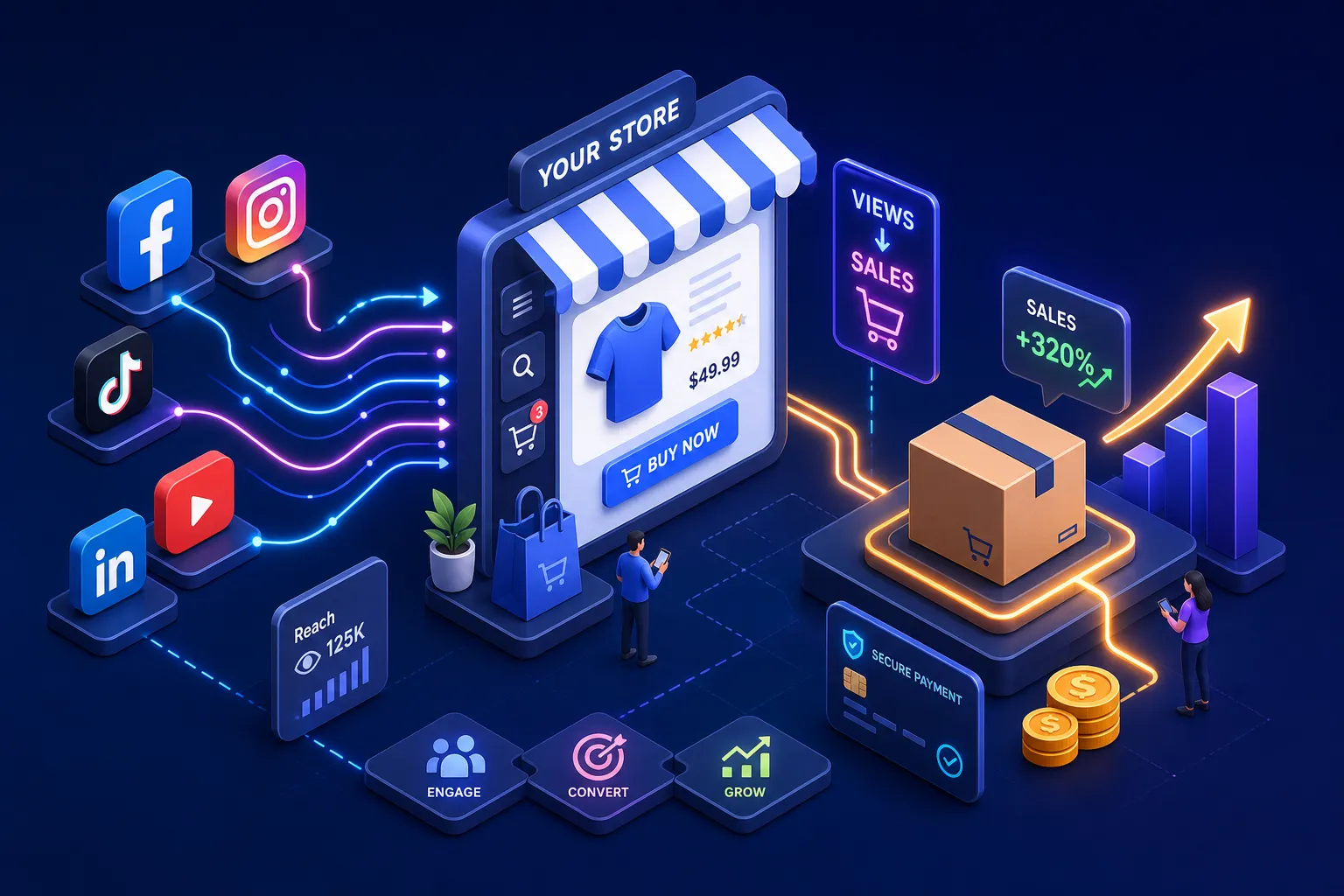
For most ecommerce brands, social media for ecommerce is still treated as a visibility channel rather than a revenue channel. Many post consistently, have a following, and get engagement. The problem is that engagement and revenue are two completely different outcomes, and many stores have never deliberately connected one to the other. A Reel that generates 50,000 views produces effectively zero revenue if the path from that view to a completed checkout is broken, missing, or simply never set up properly, this is a hypothetical that plays out in practice far more often than most teams realise.
At ClickTake Technologies, we see this pattern repeatedly when DTC brands come to the agency. The content is performing. The audience is there. But the funnel between post and purchase has never been properly built, so social sits firmly in the "brand awareness" column rather than the revenue column. This guide covers every practical decision you need to make to change that: which platform to use for your product type, which content formats drive purchase intent, how to build a connected social-to-checkout pipeline, what the 2026 benchmarks actually look like, and how to measure the revenue you are generating rather than guessing at it.
Social media for ecommerce: choosing the right platform for your product category
Spreading effort across every platform often leads to weaker performance on all of them. Platform selection needs to be a commercial decision based on where high-intent buyers in your category already discover and purchase products, not a decision based on where your competitors happen to be posting or which platform had the biggest announcement this quarter.
Instagram and Pinterest consistently outperform for fashion and apparel, beauty and skincare, home décor, accessories, and wellness products. Both platforms are built around visual discovery and aspirational browsing, which makes them naturally suited to products where the appearance of the item drives the purchase decision. Pinterest, specifically, captures buyers in planning mode rather than passive scrolling mode, and its content has a significantly longer shelf life than feed-based platforms.
TikTok performs differently. Its algorithm rewards relevance and watch time over follower count, which means new brands can reach large audiences quickly if their content solves a problem or demonstrates a product clearly. Beauty tools, skincare, tech accessories, and any product with a visible before/after or quick-use demonstration tend to perform well. TikTok is widely regarded as more impulse-friendly than most other platforms, particularly when the creative leads with a problem and solves it within the first three seconds, a pattern consistently observed in TikTok's own commerce research and practitioner case studies.
Facebook often gets dismissed by younger ecommerce teams, but its direct-response and retargeting capability remains stronger than most platforms. It works best for broader product ranges, practical lifestyle items, and retargeting audiences who have already visited your store or engaged with your social content. According to 2026 paid social benchmark data, the ROAS for Facebook ecommerce sits at around 3.71x, making it one of the most measurable social channels for direct conversion.
Content formats that drive product discovery in 2026
Platform choice tells you where to show up. Content format determines what you put there. The formats that move product are not the ones generating the most comments; they are the ones creating enough purchase intent that a viewer taps a tag or follows a link through to a product page, the engine of effective social selling for ecommerce.
Short-form video is now the dominant format for product discovery across Instagram Reels, TikTok, and YouTube Shorts. The formats that convert best share a common structure: a hook in the first two to three seconds, the product shown in context rather than on a white background, and a clear next step. Reels can outperform static creative on Instagram even with similar budgets, particularly in beauty and apparel, where showing the product in use changes the purchase consideration entirely.
User-generated content functions as social proof at a scale that brand-produced creative rarely achieves. Research and case studies consistently show that UGC outperforms polished brand content in driving purchase confidence. UK brand MAM used shoppable UGC galleries to generate £96,000 in extra annual revenue alongside a 35% increase in average order value. Influencer seeding, sending product to micro-influencers without a paid partnership requirement, produces authentic content that audiences respond to more readily than polished brand shoots. Brief creators on outcome rather than script: show the product working, not the product posed on a marble countertop.
Shoppable posts are the operational core of social commerce. When a viewer can tap a tagged product in a Reel or Story and land directly on the product page rather than searching your website from scratch, drop-off decreases significantly. Platform data from Meta and Pinterest supports the premise that reducing steps between discovery and checkout improves conversion rates meaningfully. This format is the foundation of the social-to-checkout pipeline, and setting it up properly is where most brands stop leaving revenue on the table.
Setting up your social-to-checkout pipeline
Content that performs without a connected purchase path generates awareness and little else. Building a proper pipeline means connecting your product catalogue to each platform, enabling product tagging, and then auditing every step between the initial post and the completed order. This is the work that separates brands generating traceable social revenue from brands reporting engagement metrics that never appear in their Shopify reports.
Connecting your catalogue to each platform
The setup pattern is consistent across platforms. In your Shopify admin, add the relevant sales channel for each platform: the Facebook and Instagram by Meta channel for Instagram Shopping, the TikTok channel for TikTok Shop, and the Pinterest channel for Shoppable Pins. Each requires a verified business account, a synced product catalogue, and a platform review process before product tagging becomes available. Use the native Shopify channel integration wherever possible. It is more stable and keeps your catalogue in sync automatically as you add or update products.
Auditing the path from post to purchase
Once tagging is live, audit the actual path a buyer takes. Tap a product tag in your own post and follow it through to checkout as a new visitor would. Note every point that adds delay or confusion: a slow product page, unclear sizing information, a checkout that requires account creation, or a product page that does not match the creative the buyer just saw. Each of those friction points reduces conversion. The goal is to close the gap between the intent created by the content and the action you want the viewer to take.
What the 2026 performance benchmarks actually tell you
Running social ads without knowing the realistic performance range for your platform and category means you cannot tell whether your results are good or whether something in your funnel is broken. The 2026 benchmarks provide a useful anchor, but context matters more than headline figures.
According to 2026 paid social benchmark datasets, Meta (Facebook and Instagram combined) achieves around 3.7x to 4.2x ROAS for ecommerce, with conversion rates of approximately 1.6% to 2.8%. At category level, apparel and fashion reaches 4.12x ROAS with a 3.24% conversion rate, while beauty and personal care sits at 3.94x ROAS and 2.97% conversion. TikTok benchmarks lower for standard paid social at around 2.8x ROAS. TikTok Live shopping is a different proposition: conversion rates of 8% to 12% are achievable when sessions are structured as real-time sales events with exclusive offers and live product demonstrations. The beauty and fashion categories lead on TikTok Shop in the UK, consistent with where TikTok's discovery engine performs strongest.
If your Meta campaigns are consistently producing below 2.5x ROAS with well-structured creative and targeting, the issue is usually upstream: product-market fit on the platform, audience definition, or creative messaging. If your TikTok content drives views but no clicks, the gap is typically in the transition from content to product page, not in the content itself. Use these benchmarks to identify which part of the funnel needs attention rather than as a pass/fail score on whether social commerce is "working".
Measuring social media for ecommerce revenue without relying on guesswork
Many ecommerce brands under-report the commercial contribution of social media because they rely on last-click attribution and inconsistent UTM tagging. Getting measurement right does not require expensive analytics infrastructure; it requires a consistent naming convention, server-side event tracking, and a habit of reconciling data across three sources.
Every paid and organic social link should carry utm_source, utm_medium, and utm_campaign parameters at minimum. A consistent convention looks like utm_source=instagram with utm_medium=social for organic posts and utm_medium=cpc for paid ads, with utm_campaign identifying the specific campaign or content series. Add utm_content when you need to compare creative variants, placements, or formats. Store this data at the order level in Shopify or your CRM so you can connect campaigns to lifetime value rather than only the first purchase.
Last-click attribution gives full credit to the final touchpoint before purchase and zero credit to the social post, Reel, or influencer video that started the buyer's journey. For social media, which typically operates earlier in the consideration process, this systematically understates the channel's contribution. Use GA4's acquisition reports alongside Shopify purchase data and your ad platform's own purchase reporting, then reconcile all three over a consistent date window. Where they diverge, investigate rather than default to whichever figure looks most favourable.
Your 30-day social action plan
A plan without a timeline tends not to get executed. The following structure is designed to produce measurable progress within a single month without requiring a complete overhaul of how your brand operates on social.
Weeks one and two: audit and build
Confirm your Shopify catalogue is correctly synced to every platform you use, check that product tags are live and functioning on recent posts, and implement UTM parameters on all social links going forward. Simultaneously, produce three to five short-form video posts per active platform as a working guideline, enough to test meaningfully without overcommitting resource. Vary your hooks, formats, and product contexts across those posts. The goal at this stage is not to go viral; it is to establish what your audience responds to at the content level before you commit any budget.
Weeks three and four: amplify and measure
Identify the one or two content pieces that outperformed the rest in reach, saves, and click-through rate, then do three things in sequence:
- Put a small paid budget behind those posts in a straightforward traffic or conversion campaign.
- Verify that your conversion API feed is capturing purchase events server-side rather than relying entirely on browser-based tracking.
- At day 30, pull your Shopify revenue attributed to social, compare it against your GA4 social acquisition report and your ad platform purchase total, and note the gaps.
That reconciliation exercise becomes your monthly measurement habit going forward. It is also the fastest way to see where your social pipeline is losing revenue it should be capturing.
Building a social channel that earns its place in your revenue report
Social media for ecommerce stops being a guessing game once the pipeline between content and checkout is deliberately designed rather than assembled by accident. The brands generating consistent revenue from social in 2026 share the same traits: they pick the right platforms for their product category, build content around formats that create genuine purchase intent, remove friction between post and product page, and measure outcomes in revenue rather than reach.
The 30-day plan in this article covers every one of those steps at a pace that is executable without a large team or a large budget. Start with platform selection, get your catalogue synced and tagged, and build the measurement layer before you scale spend, because each step depends on the one before it working correctly.
If you want a team that has already built this social-to-checkout pipeline for DTC brands across multiple categories and can shortcut the trial-and-error, ClickTake Technologies offers a free 30-minute consultation to scope exactly where your funnel is leaking and what it would take to fix it. That gap between social content that performs and social revenue that compounds is almost always a structural problem, one that is fixable once the right infrastructure is in place.
Want this work shipped for your brand? ClickTake Technologies delivers end-to-end e-commerceengagements — from strategy to execution to ongoing optimization — for ambitious brands across four regions. Book a free 30-minute consultation and we'll scope it together.