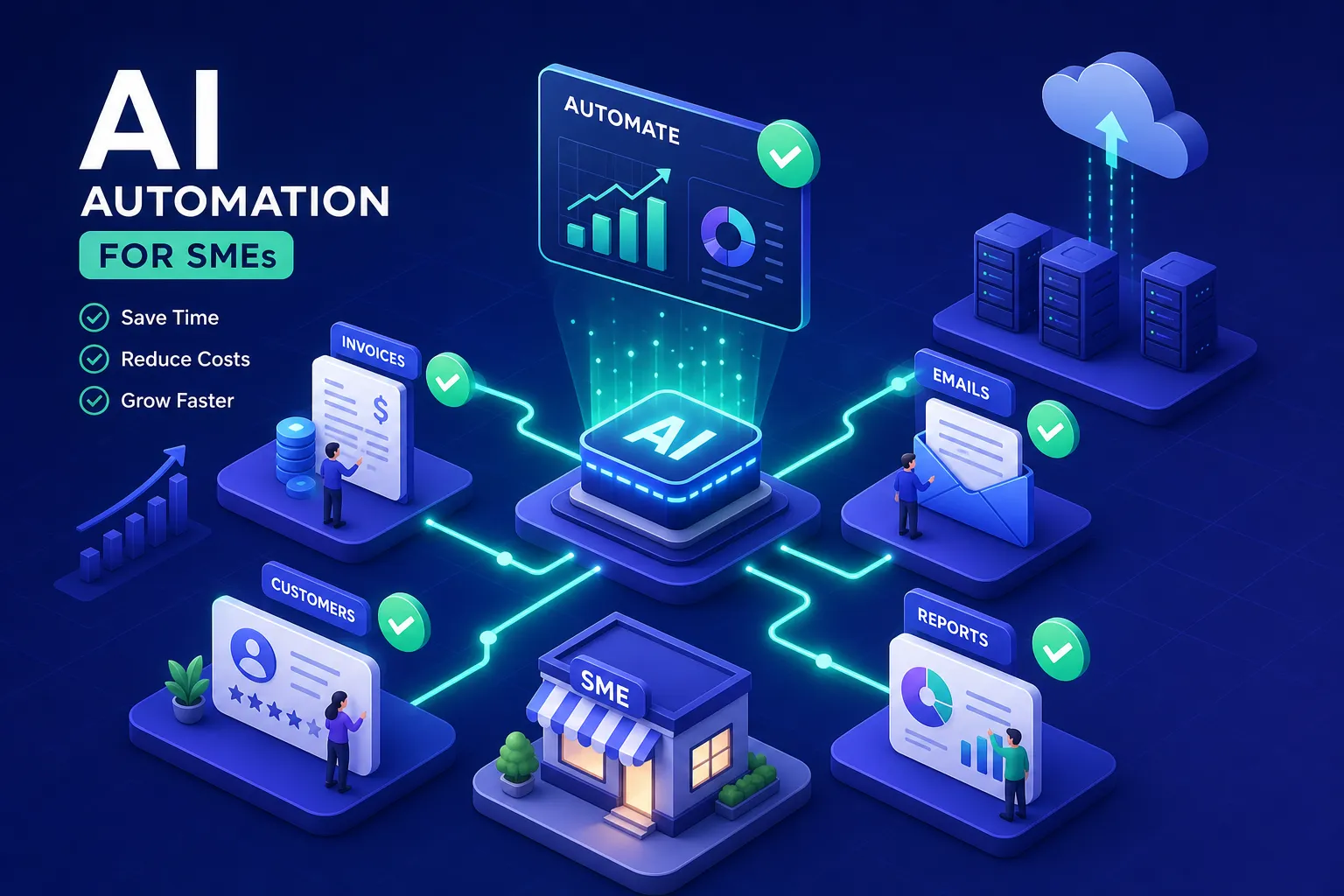
The pressure to adopt AI in business operations has never been louder. Every vendor promises transformation, every conference panel cites staggering productivity gains, and every newsletter seems to have a new tool you should have been using yesterday. For most SME owners, business automation with AI raises a specific, honest question: not whether it works in principle, but whether it will work for them, and whether the budget spent will actually show up in the numbers that matter.
At ClickTake Technologies, we have spent the past year running workflow audits for SME clients across a range of industries, mapping current processes, identifying automation candidates, and tracking what happens post-deployment. The pattern is remarkably consistent. A handful of use cases deliver measurable, repeatable returns. Several others consume time and budget without moving the needle. Knowing the difference before you commit is worth more than any individual tool recommendation. This guide maps both sides, gives you a practical framework for evaluating your own processes, and walks through a 30-day pilot structure you can run with your existing team.
Business automation with AI, high-ROI use cases for SMEs
The use cases with the strongest evidence share a common profile: high volume, clear decision rules, repetitive structure, and real cost when delayed. Set aside the marketing noise and three areas stand out consistently for SMEs pursuing AI business process automation: lead capture and qualification, content operations, and customer triage.
Lead capture and qualification at scale
AI-driven qualification chatbots score inbound leads against criteria you define, route high-fit contacts directly to sales, and log every interaction to your CRM without manual intervention. The ROI case is straightforward. Your sales team stops spending significant time chasing contacts who were never going to buy. Warm leads get a response in seconds rather than hours. Your qualification process no longer depends on which team member happens to be at their desk. Published pilots consistently report 20 to 40% reductions in manual hours for this use case, alongside the obvious upside of 24/7 availability that a human team simply cannot match.
Content operations and production workflows
SMEs using AI workflow orchestration for content are not replacing their editors or strategists. They are eliminating the low-value steps that sit between an idea and a published piece: brief generation, first-draft production, image sourcing, formatting, and scheduling. The strategic layer still requires human judgement. The mechanical layer does not. Teams running these AI-driven workflow automation setups report meaningful throughput gains, producing significantly more content without proportional increases in headcount or cost. Published case studies point to throughput improvements in the range of 30 to 50% for structured content pipelines, though results vary with implementation quality.
Customer triage and support routing
Intelligent routing cuts first-response time by classifying intent, categorising tickets, and resolving Tier-1 queries automatically before a human ever sees them. Bank of America's Erica assistant has handled more than 3.2 billion client interactions, illustrating the scale this approach can reach. For an SME, even a modest implementation that deflects a meaningful proportion of routine support queries, commonly reported in the range of 20 to 40% in published pilots, frees your team to focus on the conversations that actually require their expertise.
Where AI automation tends to disappoint
Most vendor guides stop at the success stories. The failure modes are equally instructive. Understanding where AI-driven process automation consistently falls short saves you from the expensive mistake of discovering it at your own cost.
Processes built on poor data foundations
AI does not fix bad data. It amplifies it. If your CRM has missing fields, your intake forms are inconsistently completed, or your historical records contain duplicate entries and schema mismatches, any automation you build on top will inherit every one of those problems at scale. The symptoms are predictable: misrouted leads, incorrect classifications, automations that produce outputs nobody trusts.
The fix is unglamorous but essential: data hygiene first, automation second. Poor data quality is consistently cited among the leading reasons SME pilots fail to deliver on their early promise, appearing alongside misaligned scope and inadequate change management in implementation post-mortems. Skipping the data audit is one of the most common and most avoidable errors.
Complex decisions that require human context
There is a class of workflow where rule-based logic breaks down entirely: nuanced pricing negotiations, sensitive HR matters, legal or compliance judgements, and strategic recommendations that depend on context no model has been trained to understand. AI can support these processes by retrieving relevant information or summarising options, but driving them autonomously is where errors become genuinely expensive. High-trust client interactions also belong in this category. An automated response at the wrong moment does not just fail to help, it actively damages the relationship you have spent years building.
A readiness framework before you commit any budget
Before evaluating a single tool, score any process you are considering against four criteria. This takes ten minutes and will save you months of frustration.
Scoring your processes for automation fit
Volume: Is this process high-frequency enough to justify the setup cost? A task you perform twice a month is not an automation candidate. A task that happens fifty times a day almost certainly is.
Rule clarity: Can the decision logic be written down without ambiguity? If you struggle to document the rules, AI will struggle to follow them.
Data quality: Is the input data clean, consistently structured, and readily accessible? Incomplete or inconsistent inputs produce unreliable outputs.
Error tolerance: What actually happens when the automation gets it wrong? A misclassified support ticket is recoverable. An incorrect compliance action may not be.
High-fit processes score well on all four criteria. Low-fit processes typically fail on rule clarity or data quality, which is useful information in itself, because it tells you where to focus before revisiting automation later.
Realistic budget and payback expectations for SMEs
A single well-scoped workflow automation typically runs between £2,500 and £12,000 all-in for year one, depending on integration complexity, the tools selected, and how much data preparation is required beforehand. (These figures are converted from USD ranges of approximately $3,000 to $15,000 commonly cited in implementation methodology guides, using prevailing exchange rates; actual costs will vary with scope and supplier.) Ongoing maintenance, monitoring, and support typically add £400 to £1,500 per month for anything running in a production environment, broadly consistent with USD ranges reported in published SME case studies.
A 90 to 180-day pilot ROI window is a reasonable planning assumption, commonly cited in implementation methodology guides. If a carefully scoped automation has not moved your target metric within six months, the use case or the implementation needs to change.
What measurable ROI actually looks like in practice
Across published case studies and implementation benchmarks for AI-enabled process automation in SME contexts, the ranges are broadly consistent: 20 to 40% reduction in manual hours for well-scoped pilots, 15 to 35% operational cost reduction in repetitive back-office processes, 30 to 60% error reduction in rules-driven tasks, and 30 to 45 days to first measurable gains. These figures are derived from establishing a clear baseline before the pilot begins, then measuring the same KPIs post-deployment on a defined volume of work.
KPIs worth tracking from day one
Six metrics appear consistently across published case studies and are worth tracking from the moment your pilot goes live.
Time saved per case gives you the clearest picture of productivity impact. Error rate versus your manual baseline shows whether quality is improving or degrading. SLA and turnaround time improvement demonstrates service-level impact to the rest of the business. Escalation rate, how often a human had to intervene, tells you how stable the automation actually is. Throughput change captures whether you are processing more work with the same team.
Monetised labour value converts all of the above into a figure the business can act on. That single number is what makes the scale-or-stop decision defensible.
The ROI calculation SMEs often get wrong
Most SMEs measure tool cost against hours saved and call it done. The calculation misses four hidden costs that consistently erode the headline number: setup time and integration effort, the productivity dip during the transition period while staff adjust, ongoing prompt or workflow maintenance as your processes evolve, and the staff time spent on exception handling that the automation could not resolve. Build these into your business case before you sign anything, and your projections will hold up considerably better under scrutiny.
Running a business automation with AI pilot in 30 days
The most important rule for a first pilot is minimum viable scope: one process, one measurable outcome, one small team, and human review in place for anything the automation flags as uncertain. Resist every temptation to expand scope mid-pilot. The goal is a clean, honest result, not an impressive demo.
Minimum viable scope: what to include and what to leave out
Pick one process that is high-frequency, rule-based, and currently generating meaningful manual workload for your team. Start with a 20% volume subset on historical or test data before you touch live workflows. For the first two to three weeks, run the automation in parallel alongside your existing manual process on the same items. This parallel-running phase is not optional: it is how you catch edge cases before they affect real customers or real revenue, and it is how your team builds enough confidence in the output to actually use it.
The 30-day structure that prevents pilot drift
Structure the pilot in clear phases rather than treating it as a continuous build:
Days 1, 3: Select the use case using the four-criteria scoring method above.
Days 1, 5: Establish your baseline measurements and define success in specific, measurable terms.
Days 3, 7: Audit your data sources, confirm access and permissions, and identify any quality issues that need resolving before the automation can run reliably.
Days 8, 21: Build the workflow, test it in parallel against the manual process, and log timings, accuracy, and exception rates daily.
Days 22, 30: Refine based on what the data shows, then evaluate against your baseline.
The decision at day thirty is binary: the pilot either beats baseline on your chosen KPI without creating additional workload, or it does not. Scale what works. Adjust or stop what does not.
Getting this right without the trial and error
The 30-day pilot structure above reflects industry best practice for AI-driven workflow automation and is consistent with frameworks used across published SME implementation guides. It also takes time, internal focus, and a team willing to run something new alongside everything else they are already managing. For many SME owners, that is the real constraint: not budget or ambition, but bandwidth.
At ClickTake Technologies, we run workflow audits for SME clients that identify exactly which processes are ready for intelligent process automation (IPA) and which ones need data or structural work first. The engagement is diagnostic before it is prescriptive. We map your current workflows, score them against the four readiness criteria, and produce a prioritised recommendation aligned to your business goals and available budget, including anonymised benchmarks from comparable client engagements. There is no generic software demo, no pressure to commit to a platform before you understand what you actually need.
If you want a faster path to clarity on where business automation with AI will and will not move the needle for your business, a no-obligation 30-minute consultation is the right starting point. Book yours directly through the ClickTake Technologies website.
Start narrow, measure honestly, scale what works
Business automation with AI works best when it is applied surgically, not broadly. The use cases that consistently pay off share four characteristics: sufficient volume, clear rules, clean data, and low error tolerance. Every other process should wait until those foundations are in place.
Start with one process. Establish your baseline before you build anything. Run the pilot honestly and let the data make the scale decision for you. The SMEs seeing real returns from AI automation tools for business are not the ones who moved fastest. They are the ones who picked the right starting point and measured their way to confidence before committing further budget.
If you would rather skip the guesswork, ClickTake Technologies can do the diagnostic work for you. The conversation starts with a free consultation, and it ends with a clear picture of where your first automation should be and what it should deliver.
Want this work shipped for your brand? ClickTake Technologies delivers end-to-end ai automationengagements — from strategy to execution to ongoing optimization — for ambitious brands across four regions. Book a free 30-minute consultation and we'll scope it together.